


Through the Contributions and Engagement of Our Community:
We create points of destination that share our stories, honor the legacies of our diverse ancestors, and inspire new opportunities for economic growth through Regional Heritage Tourism.
An Alliance of Resources to Create a Point of Destination That:
Educates, inspires, and builds a strong economy through Regional Heritage Tourism.

The Housing-Tourism Nexus — White Paper: A Trail To Home
“A Trail To Home” is a bi-county regional strategy for funding deeply affordable housing services and programs through tourism in the Valleys of Anza by Allison Evans, a PhD student in the Department of City & Regional Planning at the University of California, Berkeley.
A Brief Synopsis: Economic Development for Monterey and San Benito Counties Through Regional Heritage Tourism
California is the most populous state in the Nation and is now the world’s fourth–largest economy in a mere 176 years. This period is a snap of the fingers compared with the history of other countries, which spans thousands of years. In many ways, California’s relatively short historical footprint is a “living and breathing history” that can be traced back to our particular region. These stories can be leveraged to boost the region’s economy by introducing visitors to areas not currently developed as tourist destinations. The Valleys of Anza initiatives leverage the potential regional heritage tourism experience combined with two National Park Service assets — Pinnacles National Park and the Juan Bautista De Anza National Historic Trail.
The greater Monterey Bay region is an economic driver for tourism, especially along the coastline. Before COVID-19, Monterey County generated $3 billion in economic lift, and Santa Cruz County hit $1 billion just a few years ago. In the next few years, that $4 billion in tourism dollars will return, putting pressure on local coastal economies and pushing locals and tourists alike to a saturation point.
Over-tourism, harmful impacts on our natural resources, and negative experiences by locals and tourists alike have created specific pressure points in coastal communities. While these coastal cities benefit from overnight hotel stays and tourist spending, other inland nearby towns have not been able to gain the attention of these visitors. Unfortunately, a lack of a cohesive narrative and branding has limited these inland cities’ ability to attract Monterey Bay coastal tourists.
However, there is a story to tell that could change this.
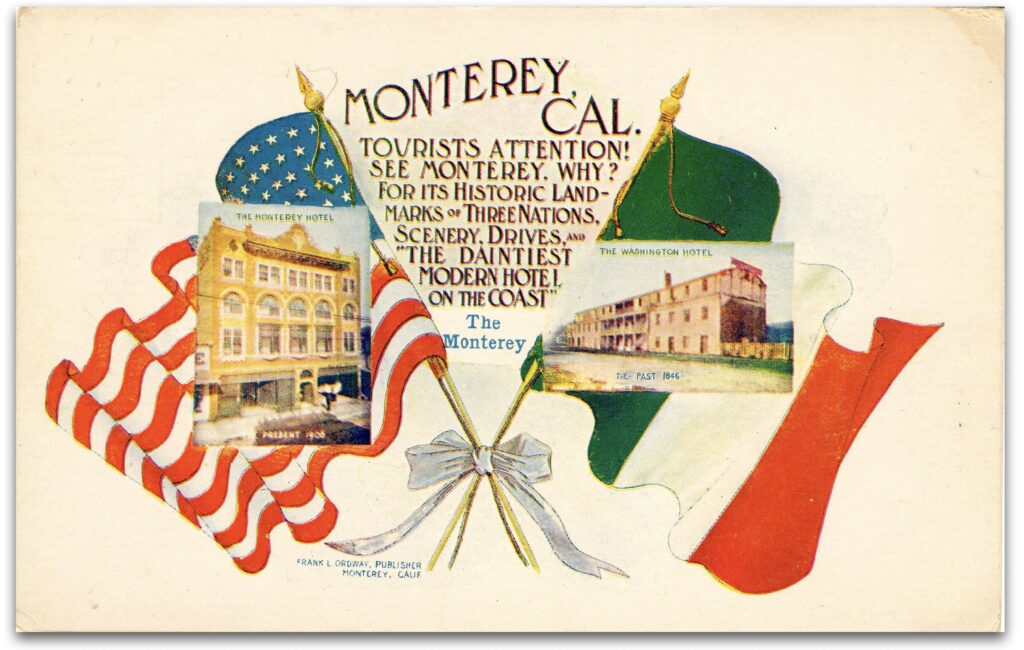
“Historic Landmarks of Three Nations, Scenery, Drives” (Postcard circa 1906)
Natural Landscapes and Early Settlements Are Windows Into Early California, Alta California, New Spain and First Peoples
Our state history shows that most valleys, like the Salinas and San Juan, as well as San Fernando and Santa Clara, were once primarily agricultural economies. The advantage that the Salinas and San Juan valleys share today is the unique distinction of not being developed beyond the initial primary use of agriculture. These two valleys are a window to our past, not just from an agricultural perspective, but also as areas pivotal to the formation of the State of California. Because these two valleys have avoided significant development, they can become our future, tapping into the tourism flow already established along the coast.
Local, old-town areas such as historic San Juan Bautista, downtown Hollister, Salinas City Center, Castroville, Soledad, King City, Greenfield, and Gonzales have, for the most part, not been cannibalized by modern construction and remain fundamentally the same as when the towns were founded. These “Main Streets” hearken back to California’s past but now have the potential to become unique destinations in both valleys.
Absentee landlords are the biggest impediment to giving these historic structures the attention they deserve. To address this, the Salinas City Center Improvement Association formed in 2015 after 217 property owners voted for it. It came with a significant annual assessment for implementing the City of Salinas Downtown Vibrancy Plan. This successful model could be implemented in other struggling historic downtowns.
The Central Coast — Santa Cruz, San Benito, and Monterey Counties — is also home to the most California Missions of any region. Five of the 21 are found in just these three counties alone. Mission San Antonio de Padua in the San Antonio Valley is the only mission still surrounded by its natural landscapes and was a major stop along the Anza Trail. The mission was only three years old when the expedition arrived.
San Juan and Salinas valleys also share unique access to Pinnacles National Park, two parks in one since a road does not connect the east and west entrances. The east side of the Park, where overnight camping is allowed, is usually booked, with lines forming at the entrance as visitors wait to get in. The west side of the Park is for day use only and sees about 1/3 of the total daily visitors. A one-way road limits buses and large RVs from navigating this entrance to the Park.
Besides sharing a national park for hiking and camping, the region also shares other trails. The Steinbeck Literary Trail traverses both Monterey and San Benito counties. John Steinbeck’s inspiration for his books and other writings, as well as his familial roots, runs through both counties.
The River Road Wine Trail in the Salinas Valley produces world-renowned wines, especially varietal pinot noir, and this scenic trail runs at the base of the Santa Lucia Highlands mountain range—a perfect location for a new outdoor attraction: a zip line. Zip Line & Wine could be another ideal pairing for locals and tourists. San Benito also has a budding wine trail outside the Hollister Hills State Vehicular Recreation Area.
 The Juan Bautista De Anza National Historic Trail
Our cultural and heritage history begins with the First Peoples and then transitions to European settlers from Spain, followed by Mexico’s control of Alta California. The early Spanish explorers forged the first trails through our region.
In 1775-76, Juan Bautista de Anza led more than 240 men, women, and children on an overland journey across the frontier of New Spain to settle Alta California. The trail is more than 1,200 miles, and the diaries kept by Anza and others detail the multi-ethnic expedition day by day.
Congress designated the Anza Trail a National Historic Trail in 1990 through an amendment to the National Trails System Act (16 U.S.C. 1241-51); the expedition occurred in 1775-1776 with the intent of establishing the first settlement at San Francisco. In our region, this trail runs along the Salinas River in the Salinas Valley, then heads to Monterey and northeast through Salinas up to San Juan Bautista. There are currently only 20 National Historic Trails in the United States.
 Connections To The Anza Trail
Two distinct county parks are very similar in their physical makeup. San Lorenzo County Park in King City and San Benito County Historic Park feature historic buildings native to the area that were moved and restored for viewing. Both parks are managed by their respective counties and are underutilized, with growing budget challenges.
Anza Trail in Monterey County: https://www.nps.gov/juba/learn/historyculture/california-anza-trail-sites.htm#CP_JUMP_767724
San Lorenzo County Park, King City:
The San Lorenzo County Park is a 200-acre site controlled by the County of Monterey. There are campsites and RV hook-ups. An agricultural museum, equipment, and the original King City train depot also reside there.
Aerial map of San Lorenzo County Park: https://www.co.monterey.ca.us/home/showdocument?id=72620
The expedition followed Sulfur Springs Canyon into Kent Canyon near King City. The camp was made north of King City at Los Ositos on the banks of the Salinas River (then called the Monterey River). Today, travelers can visit the Monterey County Agricultural & Rural Life Museum (1160 Broadway in King City) and learn how farming developed after the first settlers arrived.
San Benito County Historic Park, Tres Pinos:
Like the Monterey County Agricultural & Rural Life Museum, the San Benito County Historic Park is also underfunded and lacks sufficient marketing or ways to attract potential tourists from the coast. This site is about 14 miles from the existing Anza Trail in San Juan Bautista. San Benito County Historical Park
Anza Trail in San Benito County: https://www.nps.gov/juba/learn/historyculture/california-anza-trail-sites.htm#CP_JUMP_767725
 Creating Alternative Itineraries From The Coastline of Monterey Bay
The Anza Trail within this region can be developed for an international audience. In 1775-1776, a moving town of 240 people, with two births along the way and more than 1,000 head of cattle, forged a trail to settle San Francisco, a positive demonstration of multicultural cooperation. The diaries of this expedition can be developed into educational narratives that begin to tell the story of how California became California. Because the trail in this part of California is not encumbered by (over)development, the experience of the trail and all the other trails mentioned in this brief can be marketed to the existing tourist population found already on the coastline.
The Valleys of Anza, heritage and cultural tourism, and supporting experiences such as agri-tourism and eco-tourism all fall under the authentic experience called experiential tourism.
 The initial infrastructure to accommodate bringing tourists inland can be tested using the two parks mentioned in this brief. Because of their historic buildings and proximity to the Anza Trail, they can become additional destinations that create new overnight itineraries and “spread the wealth” from the coastal destinations of Santa Cruz and Monterey. Creating this flow of tourists to new itineraries, using five points (a geometric rhombus with an intersection) that include the cities of King City, Salinas, and Tres Pinos / San Juan Bautista, could potentially increase economic health for both counties.
Presentations:
Thank you to the City of Salinas Historic Resource Board for hearing our presentation about the Valleys of Anza.
Partners:
Press:
June 6, 2023 — Monterey County Weekly Now; “Connecting the dots between tourism and housing.”
March 25, 2023 — Monterey Herald; “Heritage Park Group Seeks Voices of Support”
July/August 2022 — California Bountiful Magazine; “Long Cool Ride”


